Original article posted in The Weekender.
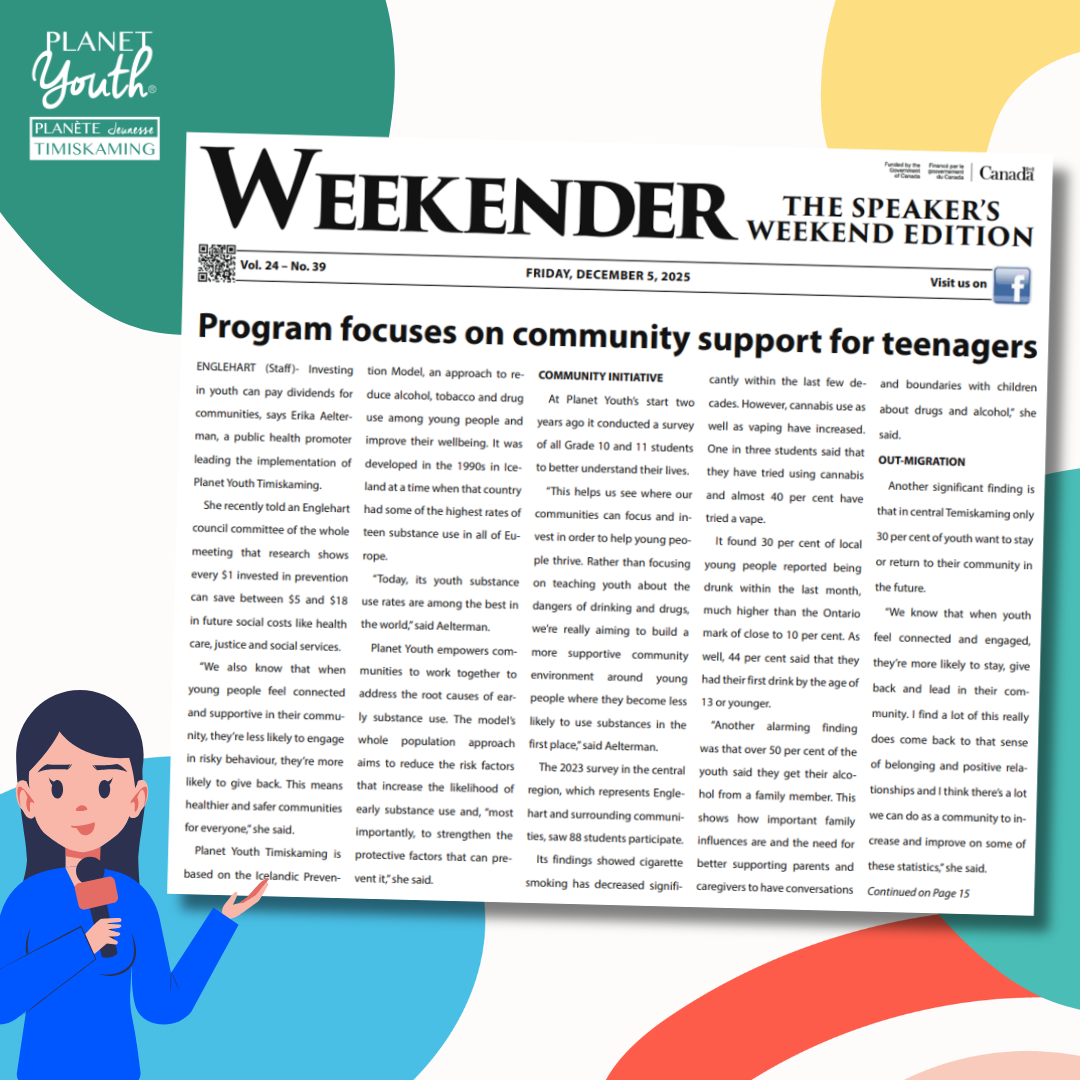
ENGLEHART (Staff) – Investing in youth can pay dividends for communities, says Erika Aelterman, a public health promoter leading the implementation of Planet Youth Timiskaming. She recently told an Englehart council committee of the whole meeting that research shows every $1 invested in prevention can save between $5 and $18 in future social costs like health care, justice and social services.
“We know that when young people feel connected and supported in their community, they’re less likely to engage in risky behaviour, they’re more likely to give back. This means healthier and safer communities for everyone,” she said.
Planet Youth Timiskaming is based on the Icelandic Prevention Model, an approach to reduce alcohol, tobacco and drug use among young people and improve their wellbeing. It was developed in the 1990s in Iceland at a time when that country had some of the highest rates of teen substance use in all of Europe.
“Today, its youth substance use rates are among the best in the world,” said Aelterman.
Planet Youth empowers communities to work together to address the root causes of early substance use. The model’s whole population approach aims to reduce the risk factors that increase the likelihood of early substance use and, “most importantly, to strengthen the protective factors that can prevent it,” she said.
COMMUNITY INITIATIVE
At Planet Youth’s start two years ago it conducted a survey of all Grade 10 and 11 students to better understand their lives.
“This helps us see where our communities can focus and invest in order to help young people thrive. Rather than focusing on teaching youth about the dangers of drinking and drugs, we’re really aiming to build a more supportive community environment around young people where they become less likely to use substances in the first place,” said Aelterman.
The 2023 survey in the central region, which represents Englehart and surrounding communities, saw 88 students participate.
Its findings showed cigarette smoking has decreased significantly within the last few decades. However, cannabis use as well as vaping have increased. One in three students said that they have tried using cannabis and almost 40 per cent have tried a vape.
It found 30 per cent of local young people reported being drunk within the last month, much higher than the Ontario mark of close to 10 per cent. As well, 44 per cent said that they had their first drink by the age of 13 or younger.
“Another alarming finding was that over 50 per cent of the youth said they get their alcohol from a family member. This shows how important family influences are and the need for better supporting parents and caregivers to have conversations and boundaries with children about drugs and alcohol,” she said.
OUT-MIGRATION
Another significant finding is that in central Temiskaming only 30 per cent of youth want to stay or return to their community in the future.
“We know that when youth feel connected and engaged, they’re more likely to stay, give back and lead in their community. I find a lot of this really does come back to that sense of belonging and positive relationships and I think there’s a lot we can do as a community to increase and improve on some of these statistics,” she said.
Youth are also sharing that they are more mature than they are given credit for; they learn from their mistakes; and they can communicate, they just need to be listened to. They don’t want to be lectured in the street or other public spaces by people that don’t know them and “please, give us a say in the things that affect us,” she said. “They’re really powerful statements that give us some insight into their reality and it’s really important that we listen to the youth in our communities because not only do they know what they need, but they can be empowered to lead or contribute to the solution as well.”
This leads to the next step which “is to share what we’ve learned and to work together to make our communities even healthier places to live and grow.” This is done by trying to understand and address what factors are putting youth at risk and what’s having a protective effect on them within their community.
Three goals were identified:
- strengthening young people’s sense of belonging and connection to their community;
- increasing access to positive leisure opportunities for youth – making them more available, accessible and diverse; and
- building community awareness of the protective factors that keep youth healthy and strong.
ACTION TEAMS
To do so, they have three community action teams across the district. These teams are composed of community organizations, youth, interested community members and volunteers.
“Together, they work to share the data that was collected and plan initiatives to build a stronger community around youth,” said Aelterman.
Funding comes from the Public Health Agency of Canada. The Youth Activity Fund was launched in February of this year when community members and organizations were invited to apply for micro grants of up to $1,500 for projects that strengthen youth sense of belonging or get them more engaged in local activities. It funded 28 projects across the district, distributing over $28,000.
This past January, youth engagement training was completed and key initiatives are now actively being rolled out Initiatives include a very well-attended cooking workshop series and the Englehart High School creative club.
Another initiative is Parent Cafes. Twenty-two parents across the district lead these cafes which are social events for parents and caregivers to connect with each other, to share their experience parenting and learn about the different protective factors that keep families strong.
Floating youth hubs follow a youth drop-in model. They usually take place in a school and provide a safe place for kids to get together with other young people their age, make connections with safe adults and try out different activities.
Planet Youth is preparing to carry out its second round of the youth survey this school year.
To learn more:
